You are the Makers of History!
  • Home
  • More Historic Pictures!
  • Books
  • Hit Us Up
  • Blog
  • Coming Events
  • Videos
  • Donations

Do the FBI/CIA Have a Role in Africa/African Diaspora Wars?

9/9/2025

3 Comments

 
Picture
 Any surface review of social media platforms will find a plethora of videos of African people from the U.S., Caribbean, and of course Africa, arguing that Africans are defined strictly by the colonial borders where we were born and raised and that beyond that, we have no historical and cultural connections to one another.  Accompanying this narrative with equal consistency are voices from Africans within the U.S. claiming that those of us born within the U.S. have zero historical and biological ties to Africa. 

Even a cursory glance at the analysis projected within all of these talking points reveals the massive holes in these arguments to any and everyone who has spent even a little time studying the history of our people.  For the anti-Africa voices, their entire framework is built upon the fragile belief that we should reject Africa because of random perspectives and voices from Africans born in Africa who know as little about our collective history as the Africans expressing this from the diaspora (outside of Africa).  For the Africa against the diaspora (primarily against Africans in the U.S.) voices, their flimsy position is rooted largely in long ago disproven white supremacy tropes that Africans in the U.S. are lazy and criminally inclined.  And unfortunately, these weak perspectives are not as alarming in comparison to the strange claims that we have no connection to Africa.  These claims take anecdotal evidence like people’s physical appearances, and a complete lack of understanding of history i.e. “where are the slave ships?” to create this fantasy identity while completely ignoring clear linguistic, cultural, and even physiological connections between Africans in the U.S. and Africa.  For example, ill refutable evidence of our linguistic connection like the fact the word mama, obviously widely used by Africans in the U.S., is actually the word for mother in Swahili.  Or, the many ceremonies, and mannerisms we share such as African women in Venezuela beating sticks into water at varying degrees to create music which is a practice originated from the Baka Forest people in Central Africa through a ceremony called Liquindi.  Then, there is sickle cell anemia which a large percentage of Africans in the U.S. house the trait if not the actual disease.  This illness unquestionably results from the out of control mutation of blood cells that only impacts African people because of the historical relationship of those mutated blood cells serving as the body’s natural defense against malaria, a disease common throughout Africa and nonexistent in the U.S.
  
Most of us have heard and participated in conversations about these unfortunate perspectives, but very little of this discourse is centered around discussing where the origins of all this disunity come from.  The suggestion here is that we consider that much of this dysfunction is most likely being injected into our communities from organized forces who have direct interest in keeping African people divided and disorganized.

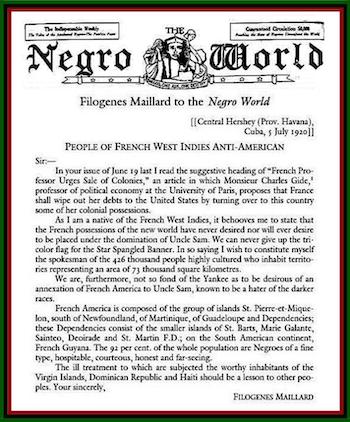
The Federal Bureau of Investigation (FBI) and the Central Intelligence Agency (CIA) have spent much of their 126 and 76 respective years history engaged in work designed to sabotage efforts at African unity and liberation.  Starting with the Department of Justice (its name prior to being renamed the FBI) and J. Edgar Hoover’s work to sabotage the cross continental relationship  between Liberia’s President King and Marcus Garvey and the Universal Negro Improvement Association (UNIA) in the 1920s.  Then to the CIA’ s sabotage of Congolese independence and coordinated murder of Patrice Lumumba, and its illegal overthrow of Kwame Nkrumah’s government in Ghana, and both intelligence agencies role in breaking up the relationship between Malcolm X’s work with Nkrumah, Sekou Ture, socialist Cuba, etc., the claims of U.S. imperialist intelligence actively eliminating African liberation efforts is ill refutable.

Just as Hoover’s and Justice Department’s work against the Garvey movement clearly illustrated 100 years ago, U.S. intelligence has always understood, even if we didn’t, the importance of sabotaging any serious efforts to link up African people across the Atlantic ocean.  Why?  Because that unity is the most potent weapon aimed at thwarting the capitalist world’s dependence on cheap African material and human resources.  Resources that fueled and sustain capitalist dominance over the world’s political and economic interests.  No matter where you are while reading this, whether it’s the architectural designs, the vehicles, the electronics, or the food you eat, Africa’s exploitation is everywhere around you.

And, since we haven’t been able to verify for sure where the origins and financing for most of these very well polished anti-African unity videos/takes are coming from, our history has taught us that we have to put everything on the table, especially the interests of the forces who benefit the most from our disorganization.  Fortunately, there is much we can do to circumvent this sabotage against us.

First, we have to acknowledge that like any and all of the efforts capitalist intelligence has made against our unity, their efforts are always only going to be as effective as our willingness to compromise and sell out our people for their interests.  Hoover’s work against Garvey was only successful because of Liberian President King’s willingness to cave to pressure as well as the self serving persons within the UNIA who were used against Garvey in a mail fraud scheme.  The disruption of Lumumba’s government in the Congo required Joseph Mobutu (Mobutu Sese Seto), originally a close friend to Lumumba and member of Lumumba’s National Congolese Movement, to become the CIA’s main man, first in the Congo, and eventually  throughout all of Africa. 

So, these sellouts making these anti-unity videos are guilty and this shouldn’t come as a surprise to any of us because the class struggle is real.  There is no such thing as racial unity without a class analysis.  There have always been Africans who would not hesitate to sell the masses out to the colonizers in Africa and the slave masters at home in Africa and across the Atlantic to the plantations here in the Western world.  And, those sellouts continue to reproduce creating the current variety who disingenuously claim colonial borders as our identity while making Africans born outside of the U.S. our primary enemies when as my mother always said “none of us have a pot to piss in!”

This is also true for the Africans from and on the continent who, embracing the class struggle of exclusion of the masses of Africans, see aligning themselves with the enemies of Africa and the African masses as their meal ticket just as their diaspora sellout kin share the same backward perspective on how to potentially build wealth by exploiting our situation instead of eliminating our collective oppression.

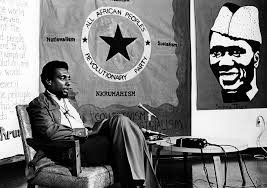
Nonetheless, the statement is true by an African revolutionary in the 1960s when asked about the assassination of Malcolm X and whether the Nation of Islam committed the act when he said “they may have fired the guns, but they didn’t buy the bullets!”  Deep in the interior, down underneath the surface, somewhere that we may not discover for another several years, the forces of intel for the capitalist system have their hands in this.  As they always have from their efforts to advance the narrative of the Black Belt South (carving out territories in the Southern U.S. for Africans), originally created by the Communist International to sway Africans away from the Garvey movement and its focus on Africa, U.S.,intelligence built upon that narrative to continue to separate us from Africa, to their confirmed work to sabotage Pan-Africanist connections for decades afterward.  Those intelligence agencies understand clearly that true African unity, across artificial colonial borders, is the key to disrupting their stranglehold on African self determination and the total liberation of Africa under scientific socialism.  It would be naïve for us to ignore that and not consider their role in all this confusion.  Kwame Ture told us – “any analysis of our people without including the work of our enemies is an incomplete analysis!”

3 Comments

Three Widely Believed Myths about Socialism in the U.S.

9/4/2025

1 Comment

 
Picture
Its 2025 so if you haven’t noticed yet, international capital and its exploitative dominance over the entire world’s human and material resources is facing its most serious challenge.  Just 35 years ago, even the then powerful Warsaw Pact, or Eastern European countries led by the former Union of Socialist Soviet Republics (USSR or Soviet Union) were not able to mount the type of challenge to the capitalist/imperialist system that its seeing today.

And this is borne out by Kwame Ture’s prophetic statement during the 1990s that the cracks in capitalism’s armor were exposed by the fact “the same white racists who attacked us in the 60s for protesting because they saw this as communist activities, are now protesting against the very same government they brutalized us in favor of!”  Ture went on to state that attacks from the right and left make the capitalist system that much more vulnerable.

None of this is to say that the capitalist system isn’t still extremely resilient.  It certainly has life to continue fighting back, but one of its most important tools in doing so is its ability to maintain its dominant anti-communist propaganda over a large segment of the world’s population.

This is evidenced by the fact that much of Europe today, at the very demand of the populations in countries like France, Italy, Germany, etc., uphold socialist influenced national programs like free healthcare, education, etc.  While doing this, these countries, including Canada, laugh off U.S. critiques of their systems as costing too much by responding that they, unlike the U.S., don’t spend 50% of their national tax revenues on maintaining war mechanisms and militaries, around the world.  And, the majority of the people in these countries happily agree with this approach while many of them would still resist any comparison between their countries and socialist development.

Of course, the U.S. is still the unquestioned leader of international capitalist/imperialist dominance and as a result, the most effective and consistent anti-communist propaganda exists within the U.S.  This can easily be demonstrated by simple experimentation.  If you go to any U.S. state, urban or rural setting, and stand on any intersection, offering passersby $100.00 USD if they can demonstrate any comprehensive book on socialist development they have read, outside of an assigned reading from school, etc., you would find no more than 1%, and that’s being optimistic, who would be qualified to cash in on your proposal. 

This reality exists due to this non-stop anti-communist propaganda that exists like the sun comes up in the U.S..  And, the three myths about socialism are just some of many that can be easily dissected, yet they continue to represent what is without question the most dominant thinking about socialism in the U.S. today.

Myth # 1 – There is no freedom of thought in socialist societies.

This one is most likely the most widely propagated and the easiest to disprove of the many unfortunate lies about socialist development.  The core of this mistruth rests in the mistaken assumption within capitalist U.S. that freedom and democracy is defined solely by being able to do what you think you want to do with no context and/or analysis.  The truth is you can do what you want in capitalist societies as long as what you want does nothing to challenge the status quo of capitalist domination.  In capitalism you can be racist, patriarchal, homophobic, and can even brag about being completely ignorant about any and everything, and all of this is not only acceptable, its encouraged within many quarters.  This is of course an extremely primitive and underdeveloped perspective on freedom.  Any healthy freedom has to require people within society to recognize not just their responsibility to themselves and their loved ones, but their responsibility to everyone.  This is what socialist development promotes.  So, in this collective mindset, a conscious socialist operating within a society committed to socialist development would have no issue in recognizing that the amount of money they can make should be limited for a time.  Not to say that they cannot make money, but to say that their ability to make money cannot result from exploitative activities that maintain class inequities crucial for the continuance of capitalist development.  For example, this conscious socialist would prefer that schools be prioritized with infrastructure.  They would demand that the elderly and sick be taken care of without the burden of worrying about the finance to do so properly.  And this socialist would always see these responsibilities as theirs as a human living in a collective society as a opposed to seeing the necessity to utilize tax revenues to fund schools as a personal financial burden that limits their personal profitability as is promoted within backward capitalist societies. 

Also, since socialist societies prioritize collective input and participation, it’s insane to suggest that capitalist societies offer more free speech than socialist societies.  Sure, from a surface perspective, capitalists can argue this point while leaving out that socialist societies haven’t been able to consolidate the values of socialism and moral incentives like capitalist societies have with financial incentives.  So, to make that comparison is like expecting an undisciplined child to understand collectivism at the same qualitative level in a selfish capitalist society as someone who has practiced and is committed to collective development. 

Deeper inspection confirms that that you truly can only say what you want within capitalist societies provided what you are saying is not opposed to capitalism and that a reasonable number of people are not listening to you.  A simple inquiry into the capitalist system’s elimination of people like Malcolm X, Dr. Martin Luther King, Patrice Lumumba, Amilcar Cabral, Thomas Sankara, Fred Hampton, Salvador Allende, Samora Machel, Eduardo Mondalane, Ernesto Guevara, etc., etc., illustrates that capitalism will end you quickly if you speak out against it in ways that undermine its stability and ability to continue to dominant.
Meanwhile, socialist construction relies on tools like democratic centralism, which properly instituted ensures that everyone’s voice is heard and all debate is fully exhausted before a decision is made.  Then, after the debate is exhausted, everyone has that collective responsibility to make a decision.  With this socialist method, if anything, the danger is bourgeoisie democracy where people who don’t do the work are still able to express their opinions without any accountability to the work, but to call this style of work restrictive and undemocratic is laughable.  This is especially true when free speech in capitalism doesn’t exist without dollars because dollars buys you the access.  There are no historical accounts of capitalist development written and widely consumed by poor people.

Myth # 2 – You cannot make money in socialist societies.

The basis of this lie is that everything and everyone is equal under socialism and work is not incented so no matter how hard you try, everyone gets paid the same.  This is also laughable.  Doctors and lawyers within socialist societies make much more than street sweepers and garbage collectors.  The fundamental and important difference is that within socialist development the value of that garbage collector and street sweeper is encouraged with the understanding that their role, although different, is as important as the doctor and lawyer.  In socialism, the type of class hierarchy that dominates in capitalist societies is openly discouraged with education having a focus on eliminating this all together. 

Another importance difference is since education, healthcare, childcare, etc., are free in socialist development, any and everyone is encouraged to pursue whichever type of career they wish because all work contributes to the revolutionary process.  So, if the street sweeper decides not to go to law school, they aren’t socially penalized for this.  That stigma doesn’t exist like it does in capitalist societies because the ability to have education isn’t decided by your elite class status, but by what contribution you wish to make to the collective society.  Once all work is respected, you will always have some who wish to be doctors and some who decide to be street sweepers. 
 
Myth # 3 – Production of products in socialism is inferior to capitalist production.

Although widely believed, another laughable concept.  If you take s cellular phone for example.  One developed in socialist societies is done under an environment of providing a necessary service to the user/buyer.  The company is state owned so this is its motivation, not profitability.  As a result, they have every incentive to build a superior product because their success is measured based on their ability to provide the people what they need, not how much money they make.  This model has been proven time and time again, but a clear example is the work of Ghana’s tire manufacturing plant in Takaradi, Ghana from 1960 to 1966 under Kwame Nkrumah and the Convention People’s Party’s socialist development.  Ghana’s socialist tire factory out produced Firestone Tire and Rubber in Liberia during that period producing hundreds of thousands of tires that performed better and lasted longer.  And, the recipe was no mystery.  Under the socialist tire factory, workers were respected as contributors to the revolution by making those tires.  They were paid respectively, provided benefits and treated as valuable members of the society.  Even within capitalist societies we know that when workers are respected, they perform better, call in sick less, and produce at higher levels.  In fact, the number one reason for worker dissatisfaction in capitalist countries is that lack of respect, not wages.
​
Meanwhile, capitalist tire production repped the same tired approach that is common in capitalist societies.  Poor pay.  Bad work conditions.  Less workers to increase profitability with higher penalties for not meeting production goals.  The fact that the neo-colonial U.S. backed thugs who illegally overthrew Nkrumah’s government in 1966 had the vision to close that tire factory immediately and sell it off to Firestone to be immediately closed, forever (it was never reopened) tells the full story.  Capitalism will do anything to prevent the people from finding out what it really is because once people find out that capitalism is nothing except a brutal oppressive system, they will learn that scientific socialism is the exact opposite of that.  As capitalism gets weaker and weaker, its ability to maintain that mirage of superiority is really the only trick up its sleeve that it has left.

  
o edit.
1 Comment

Undeniable Evidence that the Empire is Crumbling

8/5/2025

2 Comments

 
Picture
I live in the U.S., but evidence of the increasing failures of the capitalist system applies to the entire world, particularly the capitalist countries.  And, the U.S. is a very reliable measuring stick for this analysis since it has been the leading capitalist and imperialist country in the world since 1945.

Before that time, Europe, particularly Britain, France, and Germany, parallelled the U.S. in world political and economic power, but World War II knocked all of Europe down several notches.  After that dust settled, the U.S. stood as the dominant capitalist and imperialist country meaning it became the chief raider of world resources and terrorist oppression to ensure that dominance continues.

In the 1950s and 60s, that system worked pretty well for the U.S.  It was able to present itself as an alternative to European colonialism all over the world while the economic prosperity following World War II provided stable economic growth for the U.S. economy and the primarily European (white) working class elements that prop it up.

The problem, as Karl Marx told us 150 years ago, is capitalism is an exploitative system so that means its existence is dependent upon saturating the markets to maximize profitability.  Unfortunately for it, doing so, will inevitably create imbalances because it needs that imbalance to retain its profitable margins.  In other words, this is how the capitalist cycle completes itself.  The U.S. corporations create products, service and assembly line wise, but as workers and social movements around the world battle back against the inherent exploitation of capitalism, the ruling classes for this backward system have to search for more profitable arenas.  Cheap resources and labor are the keys to these more profitable arenas, but the challenge they face with that is people in these areas of the world are the ones who are doing the most effective fighting back against this oppression.  Examples are the organized labor struggles in countries like Argentina and Colombia against International Monetary Fund exploitation as well as the unified efforts within the Sahel region of Africa to come out from under the toxic control of the French CFA Franc currency.  Even within the U.S. recent victories and potential victories by labor unions like the Teamsters, Amazon and Starbucks workers, food workers, etc., symbolize a new era of labor organizing that exists outside of the dominant dependence of the liberal bourgeoisie electoral process which has defined organized labor for several decades.  And, nothing makes this point more than the level of consciousness today around the need for justice for the Palestinian people, something that only existed within the most radical sectors of activist work just a few short decades ago.

The results of all of this are Malcolm X’s classic words in 1963 when he was asked to comment on the recent assassination of John F. Kennedy.  Paraphrasing, Malcolm said that the violence the U.S. was perpetuating around the world, using the Congo in Central Africa for example and the U.S. role in assassinating the democratically elected Prime Minister Patrice Emory Lumumba, was a case of the “chickens coming home to roost!”  Meaning, when you perpetuate violence and oppression against innocent people, that violence has a way of coming back around to you.

In the 50s and 60s, the U.S. and the entire capitalist world was seen as the citadel of peace, justice, freedom and democracy.  Fast forward to today and the streets of Paris, London,  the Scandinavian countries, and New York, Los Angeles, Toronto, Montreal, etc., look like scenes from Senegal, Nigeria, India, Pakistan, Puerto Rico, Mexico, Haiti, and the Dominican Republic.  Why?  Because the instability that these capitalist countries have systemically unleashed against all of those countries has resulted in the people from those countries being forced to seek stability wherever they could get it.  The capitalist countries destroyed the possibility of finding education and jobs in African cities, so those Africans found their way to Europe, the U.S., and Canada to find those resources. 

This phenomenon has created a reality where the capitalist countries can no longer claim the allegiance of its internal populations as they could in the 50s and 60s.  This is why they get so upset in Europe, Canada, and the U.S. when people in those countries proudly wave Palestinian, Congolese, Sudanese, and Pakistani flags.  The message is clear, “we are here because you stole our birthright.  Now, we will make you implode from the inside!”

This reality explains the outrage about so-called illegal immigration in these capitalist countries.  Its simply the continued denial by those within those countries who ride or die with the oppressive empires they identify with that they are on the wrong side of history and its clearly catching up to them.

The rich within the capitalist countries are at the end of their road in being able to exploit, exploit, exploit, with no push back from the masses.  There are countless surveys circulating within the U.S. today that demonstrate that upwards of 50% of persons 30 years and under have a favorable view of what they conceive to be socialist construction and policies.  And, all that does is place the U.S. in line with the populations in the rest of the capitalist world.  Obviously, there is a long way to go before any victories for socialist consciousness can be claimed, but it would have been absolutely impossible in the 50s and 60s to have even 3 to 5% of the any population segment express any level of positivity towards socialism in any way possible.

So, instead of being shocked by the outward racist, patriarchal, and homophobic rhetoric, see it for what it actually is.  Instead of feeling depressed because racists are confronting people in McDonalds, see it for what it is.  Rural European communities are waging protests against the U.S. government for its anti-human policies in healthcare and social services.  The rich are having to eat the poor in order to maintain their profitability and the working poor are not accepting this lying down.  Capitalism is in its last legs and even if some of us don’t know it, the capitalists know it.  Their desperation attempts in recruiting Indigenous people in the West and Africans to denounce their communities with long discredited racist talking points, like all these other last ditch efforts, is nothing more than the actions of a cornered cat fighting for its very survival.

Every significant economist with a social lense predicted the decline of capitalism from Luxemburg to Marx to Rodney to Nkrumah to Ture, to Castro, etc., etc.  In fact, Fidel Castro has a book entitled “Capitalism in Crisis” that was released in the late 80s/early 90s.  That book is so prophetic for today’s reality that its like Castro hasn’t been deceased for almost 10 years and instead is sitting in Havana today writing notes about what’s happening.

All every peace and justice loving person need do now is ensure that you are getting your mind, body and spirit prepared.  Maintain that constant political education so that you can see the end of capitalism as simply the beginning of a better socialist reality.  Continue reinforcing your work so that you continue throwing oil on the fire.  View every conversation as an opportunity to fight back.  You never know.  The person you are talking to can become the next Malcolm X, Teodora Gomes, or Ella Baker.
Contrary to the lies being vomited over and over, the world never started with capitalism.  Human progress never stands still.  Capitalism is the dialectical outgrowth of colonialism and slavery.  It replaced feudalism as the dominant economic system in the world today, but even right now, feudalism, like its predecessors communalism and slavery, still exists in pockets around the world.  One day soon, capitalism will join communalism, slavery, and feudalism, as former systems of dominance in the world.  And the people’s of the planet will have their time to shape scientific socialism in the ways needed.  For African people that will manifest itself in the creation of one unified socialist Africa.  For others, it may look different, but all of this work will serve the purpose of advancing socialist construction for the following stage of human development i.e. world communism, and so on and so on.  Kwame Ture could not have provided a more accurate example of this when asked about why he moved from Black power to Pan-Africanism.  He said that in the 60s, the struggle was dominantly defined as a struggle against racism so the African masses within the U.S. identified a forward thrust from that as declaring our Blackness as a shield against racism.  Then Ture went on to assert that as time evolved, they began to recognize that the struggle was much more than a fight against racism.  It’s a fight for power and power means land and resources and the only land we have rights to is Africa, thus Pan-Africanism.  Human progress never stands still.  The only people who want us to believe that it does are the people who benefit the most from it standing still right now in this moment in history.  Soon, they will be eternally proven wrong. 
 

2 Comments

These "We Should Sit Out Protests" Folks Don't Speak for Activists

6/11/2025

3 Comments

 
Picture
Just this morning I saw a social media video reel of an African (Black) man railing against the protests in Los Angeles.  We realize that everyone everywhere has earned a PhD from Youtube, but the logic this dude articulated criticizing the protests (and expressing why African people should not be in support of the uprisings) was below even the most primitive manifestations of sanity.

He said that unlike the African civil rights movement of the 1960s, “they are breaking the law in Los Angeles!”  Apparently, the institutions of Youtube PhD’s in social activism neglected to include the component that explains to people like this dude how everything African people protested against was legal, meaning just by standing up for our dignity, we were breaking the laws of this system.  Colonialism in Africa was legal.  We resisted it.  Slavery was legal all throughout the Western Hemisphere, including of course the U.S.  We resisted it.  Jim Crow racial segregation from the late 1800s through the 1970s was legal.  We resisted it.  No African today would be able to attend universities outside of the historically African ones if we hadn’t been willing to break the law.  No African today could have access to employment and other opportunities if we hadn’t been willing to break the law.  No African could live where they wanted and could afford to live if we hadn’t been willing to break the law.  Anyone who has even the slightest understanding of social activism knows that the foundational basis of it is building a collective movement to struggle against unjust laws so by definition, all struggles for justice and dignity are going to break laws.  The point being anyone who knows anything about the African struggle for justice realizes how absurd it sounds in 2025 for anyone who looks like us to be sitting up there complaining about people breaking laws in the name of justice. 

The other absurd thing these African people are saying is the exact same backward talking point the capitalist system has been spewing against the most radical elements of our struggle for the last 60 years i.e. the critique against urban uprisings.  And we mean the same tired talking points.  They don’t even have the ability to come up with anything new.  “You are destroying your own communities!  What good will that do!”  Malcolm X literally deconstructed this empty argument 60 years ago.  He said that the masses, sick of exploitation and discrimination, rise up in righteous anger, but the people behind their suffering don’t occupy the same physical spaces that they do, so they lash out against the resources and symbols of the power structure.  Police cars being targeted is without question a clear and logical example for people to make this point.  Just as people have targeted Teslas for destruction.  These same reactionaries decry why the people who have pushed for electric cars would destroy them, but no one is destroying Priuses.  The targeting of Teslas is a clear statement against the multi-national corporation that produces them, not the car/truck itself.  The people are clear in their messaging.  An example of this was from 1992 after the Los Angeles uprising after the acquittal of the four police accused of viciously beating motorist Rodney King.  Oprah Winfrey went to South L.A. to film her show.  Her audience was filled with local residents.  She condescendingly asked one young African “what did you accomplish with these riots?”  He took just one second to say “it got you here!”

These African social media commentators are also criticizing the carrying of Mexican flags, saying that “if they love Mexico so much, why don’t they just go there?!  Why are they protesting in our country?!”  This “logic” is a supreme example of the absurdity of these arguments.  Even a fifth grader can understand that the Mexican flag is an expression of dignity since the ICE raids into peoples residences and on people on the streets is a clear assault against that dignity.  The flag is a call for self respect and unity, rooted in the truth that California was stolen from Mexico and the Indigenous people to begin with.  And, its utterly amazing that these African commentators can completely ignore that during our recent protests for Black lives, etc., Red, Black, and Green flags are commonly displayed, we would argue for the same reasons the Mexican flags are being displayed.  Our flags are not being displayed because people want to go anywhere.  As Pan-Africanists we wish this was true, but we are not at that collective level of consciousness yet about Africa (although we are moving in that direction).  We know that the presentation of these flags is clearly a statement of dignity.  We also know that the same capitalist logic that condemns the use of the Mexican flags also condemns the use of our Pan-African flags.  We know this because as the European comedienne said some years ago “I love minorities, as long as you act white!”  The flags of resistance serves as yet another important symbol of rejection of this capitalist white supremacist empire and the power structure knows that, even if these ignorant commentators don’t.

Last, but not least, the foundation of everything these commentators are expressing is their calls for African people to sit out the protests.  Of all of their insanity, this one sits at the top of the list.  Only a lower level animal such as roach suffers from such unconsciousness.  If roaches are crawling and you kill one, the others will not come to help the fallen comrade. They will either seek safety or continue on with their duties.  As human beings, even on the most basic level, and especially as Africans, each and every one of us cannot be confused enough to believe that the gestapo actions aimed at the Indigenous communities in Los Angeles will stop there.  Only the most foolish and brain dirtied African would truly believe that the state will wage such a violent assault against any people, yet we are safe because we are “Americans.”  Any African today that confused is without question a disgrace to all of the struggle and sacrifices our ancestors contributed.  If anything, these actions are just the first phase of Europeanizing the U.S. which means these Africans who are working so hard to push their heads up the rear ends of the capitalist system are next for the gestapo actions by the state.

Of course the fundamental problem with all of these rightwing and liberal African commentators expressing how none of what’s happening in Los Angeles is our concern as African people is that clearly, none of the people saying this are activists.  They do not belong to activist African or anybody else organizations.  They are not involved in our ongoing struggle for liberation and forward progress.  They are just sad and confused people who sit behind computer screens.  Most of them, by their own admissions, have never even attended a single protest.  They certainly haven’t organized anything, not even the vomit coming out of their mouths.  You would not accept someone conducting surgery on your body who had never studied and practiced medicine.  You would not permit someone who has never studied or trained to work on cars to disassemble your car engine.  So, why would you listen to people who have clearly never studied social justice struggles and never participated a day in our struggle for justice to provide you with an analysis for how you should see any social justice efforts?
​
These people on social media are saying the things they are saying to get likes and clout as a tactic to build their brands and open doors to paid endorsement of their content.  For them its exactly what Malcolm also told us – “they say exactly what the white man wants them to say!”  Those of who have been organizing on the streets for decades know better than this charade.  We know that Dr. Martin Luther King Jr. was 100% correct when he said “a threat to justice anywhere is a threat to justice everywhere!”  King’s logic is ill refutable to anyone who is serious about life.  The only exceptions are those who view our people and our existence as a means to an end.  Those people will never speak for us.  All they will do is what they always do, sit back, run their mouths, and then come in after the dusk clears to sweep up the benefits they can pilfer from everyone else’s genuine sacrifices. 
3 Comments

Why Malcolm X is Still Relevant To Us 60 Years After His Death

5/20/2025

0 Comments

 
Picture
May 25th, 2025, commemorates 100 years since the birth of El Hajj Malik El Shabazz or Malcolm X.  By now, many people already possess some knowledge of his life, primarily the least formidable elements which have been personified by capitalist efforts to redefine his image.  His transformation from petty street hustler to renowned activist, and revolutionary organizer.  The belief that Malcolm learned to read and write by reading every word in the Websters dictionary.  His attention to developing intense discipline and largely, his ability to take the most complex political conditions and break them down into language every day folk can easily understand.

All of those elements about Malcolm are true and magnificent, but none of them accurately capture why his life is so relevant today exactly 60 years after his assassination (February 21,1965).  So, what is it about Malcolm that makes him still so attractive to entire generations of African and non-African people who were not even alive yet while he did his work?

The most important attributes from Malcolm, even if invisible to the naked and untrained eye, start with his complete dedication to principle and his unwavering courage in confronting the enemies of humanity.  Most people, even in 2025, choose to ignore the obvious contradictions within this capitalist dominated world because addressing them still comes with consequences.  Whether those consequences are serious ones like being pursued by gestapo police agencies are just losing a job, most people prefer to avoid the type of conflict that people like Malcolm run towards.  He was without question unafraid to call out the injustices being perpetuated against the African masses worldwide.  His characterization of the conditions in the Congo in Central Africa mirroring conditions in Mississippi in the U.S. was so courageous because certainly in 1963 when he made the analysis, it was viewed by mainstream capitalist media (correctly) as a bold denouncement of the capitalist world in the middle of a heightened cold war atmosphere.  His appointment by the Harlem Committee to meet with Fidel Casto from Cuba in 1960 was a move plenty of people would reject in 2025, meeting with the newly emerged leader of the first socialist leaning (at that time) revolution in the Western Hemisphere.  His open endorsement of Africans training with firearms and his open letter to violent white supremacist groups in the Southern U.S. that he would organize a continent of African militia persons to engage them if they did not stop harassing civil rights workers.  All of these things and many more easily convey the courage of Malcolm X when very few people were willing at that time to express the radical views that he articulated so eloquently.

And, although his courage is undeniable, probably his most important contribution has been his vision as it relates to African liberation on a worldwide basis.  Even before his break with the Nation of Islam, which can only accurately be described as his ideological growth beyond the realm of which the Nation operates, Malcolm displayed this vision.  His debate at Howard University in 1961 against Bayard Rustin (at the invitation of Student Non-Violent Coordinating Committee – SNCC – organizers on campus including the young Kwame Ture – formally Stokely Carmichael), planted the seeds for SNCC’s eventual evolution from an organization primarily influenced by the philosophy of Rev. Dr. Martin Luther King Jr. (freedom now!), to one clearly more in line with the thinking of Malcolm X (Black power!).

SNCC’s invitation to Malcolm to speak to them in Selma, Alabama on February 12, 1965, just nine days before he was taken from us, is a clear gauge of his growing influence, despite the efforts by the movie “Selma” to dismiss his presence with SNCC 

(as well as diminishing all the militancy of the movement inside of SNCC, etc.).  His brilliant analogy of the “chickens coming home to roost” on December 1, 1963 in response to the question about the assassination of John F. Kennedy, not only openly defied Elijah Muhammad’s directive to all Nation of Islam ministers to refrain from commenting on Kennedy’s death (Malcolm clearly knew he had one foot already outside of the Nation anyway), but more importantly, his remarks were such a clear demonstration of the contradictions of international imperialism, capitalism’s continued exploitation of Africa and African people, and his growing Pan-African consciousness.

Its that Pan-African consciousness that is really Malcolm’s most lasting impact.  Despite efforts by those loyal to Elijah Muhammad and the Nation to claim that Malcolm was solely a product of the Nation, we must remember that Malcolm’s parents – Earl Little and his Caribbean born mother Louise Little – were active members of Marcus Garvey’s Universal Negro Improvement Association, an unapologetically Pan-African organization.  Its 100% illogical to suggest that none of that rubbed off on Malcolm.  What makes more sense is that Elijah Muhammad gets credit for waking some of that dormant consciousness within Malcolm, but once that process started, it continued to evolve beyond the Nation of Islam.

In fact, the argument can be made that without those last 11 months after Malcolm left the Nation of Islam, he would be not much more than one of the many dynamic ministers that existed within the Nation i.e. Louis Farrakhan, Silas Muhammad, Jeremiah Shabazz, Abdul Allah Muhammad, etc.  Of course, Minister Farrakhan’s work over the last 48 years he has spent rebuilding the Nation of Islam after Muhammad’s death in 1975 is obviously noteworthy for many reasons, it can be argued that Farrakhan’s impact on the African masses doesn’t extend any farther than that of Malcolm, certainly not internationally..

And, the last statements are validated by Malcolm’s work in those last 11 months.  His travels and consultations with Kwame Nkrumah in Ghana, Sekou Ture in Guinea, Gamal Abdul Nasser in Egypt, etc., cemented Pan-African consciousness in the modern era, not only in the U.S, but around the world.  When Sekou Ture invited a delegation from SNCC to Guinea in 1964 (led by John Lewis, Ruby Doris Smith Robinson, Ms. Fannie Lou Hamer, Cleve Sellers, etc.), John Lewis recounted in his memoir that everyone in Guinea wanted to know what SNCC’s positions were in contrast to Malcolm X who had traveled there a short time before.  Lewis recalled that any detection of lesser militancy than that which was articulated by Malcolm in Guinea was cause for the complete discrediting of the SNCC organizers, an organization which was in the forefront of the most courageous civil rights work ever to happen in this country.  Still, Malcolm’s influence in Pan-African organizing work as illustrated by the words of those SNCC organizers in Guinea, his impact on people in Ghana, starting with Kwame Nkrumah who strongly encouraged Malcolm to move to Ghana and work directly with him to organize for Pan-Africanism, to Alphaus Hunton, Maya Angelou, and others who were living in Ghana already, but clearly saw Malcolm’s presence there as a guiding light for what they felt their role should be in Pan-African work.

The core of Malcolm’s Pan-African consciousness can be summarized in the statements he began making in those last months of his life i.e. “we are Africans!  If a cat has kittens in the oven, you don’t call them biscuits!”  Anyone who is a capitalist is a blood sucker!”  “You haven’t left anything in Africa?  Why you left your mind in Africa!”  These remarks and many more like them are carefully organized in the book of Malcolm’s speeches entitled “The Final Speeches of Malcolm X”.  This book shouldn’t be confused with “The Last Speeches of Malcolm X” as the Final Speeches book is a chronology of Malcolm’s final 11 speeches before he was killed which articulates a clear analysis about his revolutionary Pan-African consciousness.

In 2025, most people who see Malcolm as an inspiration are not as well versed about his Pan-African consciousness on the surface as they are about his individual characteristics, many of which certainly deserve respect.  Still, our freedom and liberation cannot be carried out by any one person, no matter how great they are.  Only the masses of people make history, not individuals.  So, the essence of Malcolm X in 2025, and why his inspiration is still so prevalent, is his life, particularly those last 11 months.  His uncompromising commitment to justice.  His focus on our connection to Africa and necessity for Africa to be free, we would argue, provides credibility to the principles he articulated because Africa’s liberation is the most just solution for African people, particularly those of us in the Western Hemisphere who (despite how many false identities we create for ourselves due to our ignorance about Africa) who have no legitimate claim to any lands besides Africa.
​
We would suggest that Malcolm’s commitment to truth and seeking it in an honest and uncompromising way are the values that make him so attractive even today.  Everyone desires to have that type of integrity and dignity.  No amount of money, material possessions, and fame could ever give any of us the pride that we feel when we demonstrate the level of dignity we see in Malcolm.  And, it was Malcolm’s march towards his mission in life – his connection to the worldwide struggle for African self-determination – which is the engine that fueled his dignity.  Even if many of us today aren’t able to make that level of connection as to why we love Malcolm, that is just a matter of time before it becomes more and more clear.  Any solution for African people anywhere on earth has to have Africa at its core.  Malcolm grew to understand this and we would argue that it was this realization that powered his courage and all the other attributes that make him so popular today, 100 years after his birth and 60 years after his death.

0 Comments

These Shameless Black Petti-Bouregoisie Sellouts are Everywhere!

4/16/2025

0 Comments

 
Picture
As if an infectious fungus has started sprouting everywhere, these African (Black) petti-bourgeoisie voices are seen and active on all social media platforms at all times.  From these African men making systemic and vicious attacks against African women to the chorus of cries that “we aren’t African because I’ve never been to Africa and know nothing about it.”  Then there are the ones who really attempt to argue that African people are native to the Western Hemisphere.  Also, the ones who openly and proudly articulate age old discredited racist tropes that Africans sold each other into slavery, colonialism was a choice, and African people commit all the crime, etc., etc. 

Why are these people being labeled as petti-bourgeoisie?  The answer is rooted in the class analysis provided to us by the great ideologues of the African revolution – Kwame Nkrumah, Sekou Ture, and Amilcar Cabral – or, as we call it – Nkrumahism/Tureism/Cabralism.  Within this analysis, the relation of human beings to the class they belong to goes beyond the Marxist/Leninist assertion that class is defined exclusively through a person’s material relationship to the means of production.  Within Nkrumahist/Tureist/Cabralist thought, materialism is primary, but ideology is also a critical component in how class representation is determined and defined.  In other words, these African clout chasers are adopting these clearly ahistorical stances, not likely because they have deep philosophical commitments to their ideas.  We know this is not the case because not one of them can offer a single shred of material evidence to demonstrate their rantings.  Nothing to prove from a historical, linguistic, anthropological, etc., perspective that we don’t come from Africa.  They don’t even attempt to explain how our relationship to Africa can ever be defined by our ignorance about Africa.  And, beyond their anecdotal railings, they cannot articulate anything worth discussing about African women being problematic.  Their motivation is purely to gain clout with those who have power within the capitalist system in the hope that they will be recognized for their loyalty to capitalism and rewarded with positions of privilege inside of the capitalist system.

These acts of class betrayal reflect the commitment on behalf of these people to abandon any semblance of intellectual honesty in order to replace that principle with naked opportunism.  This is the very definition of the petti-bourgeoisie class which exists to ensure the interests of capitalism are upheld and protected.  And, it’s the Nkrumahist/Tureist/Cabralist ideology which provides room to make this definition based upon ideological commitment so that we can easily define these traitors this way, even if many of them possess none of the material characteristics that would define them as petti-bourgeoisie.

Malcolm X told us about these people 61 years ago.  Being interviewed at the University of California Berkeley in 1962, Malcolm was told by the European interviewer that African celebrities like Jackie Robinson had been very critical of Malcolm and the Nation of Islam.  Malcolm responded that nowhere in the white community are entertainers looked upon as leaders of the white community.  He continued that these people are set up by the white power structure to say and do the things that endear them to the capitalist system so that they can position themselves to receive any potential rewards that may come their way for their work against our people’s advancement.

Today, with the proliferation of social media, this phenomenon has grown far beyond just celebrities to any piece of bottom shoe scum with an internet account who creates a vision of monetizing their social media presence.  Everyone doesn’t know this, but the power of the capitalist classes continues to be their ability to control the masses of people, particularly the African masses since their capitalist system was built and is maintained based upon exploiting Africa’s human and material resources. Even with little understanding about the last sentence, most people do have some understanding that the quickest way to position yourself in the favor of the super rich is to adopt their anti-Africa, anti-African line and the pathway to do this is potentially more lucrative if you are African and willing to be that type of sell out mouthpiece.

And, its clear that this strategy is working for so many of these people.  Take this Myron Gaines character.  He has built a lucrative monetization on social media that extends to paid speaking engagements, podcasts, etc., based solely on spitting upon the legacy of African people, particularly African women.  The more vulgar he gets about ridiculing African people/women, the higher his stock within the capitalist world.  This is the model that so many of these clout chasers are pursuing, but justice loving people should see this as an opportunity.
​
Back in the early 1960s, one of the capitalist news outlets was at the house of Eljah Muhammad, interviewing him.  The reporter asked Muhammad if he was afraid.  Muhammad responded by simply saying “no.”  The reporter asked him why not?  Muhammad quickly answered “because I have the truth.”  This is the premise under which justice seeking people must proceed.  Sekou Ture told us that a thousand lies can be crushed with one truth and this is borne out by the fact that a single principled African who knows their proud African history, especially the outstanding contributions to that history by African women, can easily defeat one hundred of these jester clout chasers at the same time.  Those of us who have these social media skills must see now as the time to use them.  If you can create the optics, but don’t have the historical understanding, connect with those who do and feature them and vice versa.  We must continue to write and stand on truth and justice.  There are many of us who have weathered these storms many times so we know that Ture was also correct when he said “truth crushed to earth a thousand times will always rise again!”
0 Comments

An Anti-Patriarchal Campaign is Something We Can Start Today!

3/4/2025

8 Comments

 
Picture
Similar to commemorations around African history, recognition of women’s history has evolved to include the entire month of March annually.  Of course, for conscious students of history, women’s history, and the history for all oppressed humanity, is every day all year long, but since we have March dedicated to focusing on women, we should use this as a tactical imperative.
And let us be clear that as African revolutionaries, we will use March specifically to focus on the contributions of African women freedom fighters.  The focus should also extend to marginalized gender African people, who make uncompromising contributions to our people’s forward liberation.

This focus is absolutely necessary because patriarchy is a chief appendage of the international capitalist and imperialist systems.  What this means is capitalism/imperialism institutionalize the systemic oppression and exploitation of women and marginalized gender folks as a tool to uphold the status quo.  In other words, without white supremacy, patriarchy, homophobia, etc., it would be much easier for people to see that the primary contradiction that adversely impacts their daily lives is international capital.  For example, as Europe, zionist israel, the U.S., etc., experience the continued decline of international capitalism, the response of this system is ratcheting up fascist policies.  This is done to focus people’s attention on the oppressed as the cause of their suffering, instead of the system itself.  Patriarchy and the other appendage sub-systems of oppression play their roles well in maintaining a smoke screen around these questions.

One of the manifestations of these disparities is African women who stand up against injustice, who dedicate their lives to fighting against systems of oppression, are completely written out of history.  This is why if you chose 10 people from anywhere in the world and ask them to identify two women by picture, one of those women being Cardi B the entertainer from the U.S., and the other being Teodora Gomes the revolutionary activist from Guinea-Bissau, eight out of ten of those people, regardless of where they are born or live, would properly I.D. Cardi B while not even one out of ten could identify Teodora Gomes.

This isn’t intended to be a knock against Cardi B who is an unquestionably talented young woman.  The point is the Cardi B’s of the world offer no threat to the interests of the capitalist system (in fact, most of the time they uplift those interests).  This is the reason non-revolutionary women are provided unlimited platforms to the extent that the values they represent are normalized.  Of course, on the other end of the spectrum, radical, revolutionary African women are marginalized as insane, unreasonable, and unworthy of recognition and respect. 

Imagine for a moment a world where we are able to develop collective consensus that a campaign to advance the notion of revolutionary African women is endorsed.  If we take African populations for all 58 areas in Africa, countries and islands, Europe, and the Western Hemisphere, that’s an estimated 2.5 billion people of African descent.  Factoring in the daily and continued anti-Africa/n propaganda from the capitalist/imperialist system (“I’m not African, I’m…”) and the general malaise and individualism which characterizes existence in this profit over people world we currently live in, let’s just say our campaign starts out small at two (2) percent, meaning just 2% of our people are on board to do the work of this Campaign for Consciousness Around African Women.  That’s 500,000 people out of 2.5 billion.  Even in this current world, that’s not an unrealistic number, but we can reduce it even more and say only 0.5% percent are participating, or 125,000 people.

This 125,000 people generates a campaign budget and using crowd sourcing and other materials, funds are raised to wage the campaign.  Most logical people would agree this is achievable.  Included in that work would be the development of materials in the primary languages that African people speak worldwide like English, Spanish, Portuguese, French and Swahili.  To this some of you who don’t have the revolutionary Pan-Africanist organizing experience that those of us in organizations like the All African People’s Revolutionary Party possess, you may think this impossible.  The good news for you is we have already started doing this with multiple languages in our international Pan-African work so this is entirely possible. 

Then, the campaign goes to work instituting educational initiatives everywhere for young people (and not so young people) and doing that work on a consistent basis all over the African world.  There is curriculum designed to normalize the lives, work, and examples of African women like Shirley Graham DuBois, Andree Blouin, Imbalia Camara, Teodora Gomes, Titina Sila, Carmen Peirera, Elizabeth Sibeko, Assata Shakur, Mawaina Kouyate, Gloria Richardson, Ethel Minor, Fatima Mohammad Bernawi, Amy Ashwood Garvey, Amy Jacque Garvey, etc.  Notice that none of these women are business owners, politicians within the capitalist system, or entertainers.  All of them are freedom fighters, most of whom either organized, supported, or participated in armed struggle against the enemies of Africa and humanity.  Certainly, all of them upheld the principles of justice and forward human progress over individual comfort and advancement into the capitalist system.

What if we engaged in a campaign like this?  At the very least, we could count upon seeing an increased consciousness of the conditions of women, respect for women, and a much greater understanding that we as men cannot even ever imagine freedom and self-determination without the question of women’s freedom being front and center to everything that we do.  The campaign would normalize an understanding of the word patriarchy and its daily manifestations in the lives of African women.  This would raise the bar considerably for all people and increase the commitment to see this system eradicated.  This reality automatically translates into more people joining organizations and therefore owning the change that they now see the importance of.

The question about how to get men on board with this type of campaign is answered by strategically making this question the center of our lives for a period of time i.e. an annual campaign, internationally.  Men being required to do this work and uphold the principles of such a campaign.  It will take a lot of principled struggle, but this is the stuff in which worthwhile campaigns are built from.

It should be easy enough to see how this type of work raises the bar for men, women, and margainalized gender folks which raises the bar for our people overall in our struggle for justice.  Something like this isn’t rocket science and its not reinventing the wheel.  Every successful campaign to improve people’s consciousness has been carried out this way from the literacy campaign in the Cuban revolution in the early 1960s to the anti-women castration campaign carried out by the Popular Movement for the Liberation of Angola in Angola in the 1970s (of course the imposition of International Monetary Fund destruction of social campaigns pushed back those gains in Angola in the 2000s).
​
For African men who claim to be anti-patriarchal, this should be a call to action.  For women who work for anti-patriarchal change, humbly speaking, this is a suggestion for how to attack problems you wake up daily contemplating how to engage.  The only thing holding us back from doing this work would be our unwillingness to try.  We certainly owe our future generations our best and most sincere efforts to change.  When I once asked my father (rest in power) whether I should go back and get an advanced degree, his intelligent response to me was “If you live long enough, you will be 50 one day.  You’ll either be 50 with an advanced degree or 50 without one, so you may as well have one!”  This incredible logic came from a man who wasn’t even able to complete high school due to Jim Crow segregation in the U.S.  The same logic applies to implementing this type of ANTI-patriarchy campaign.  This is a call to action.  Who will respond?

8 Comments

Kendrick Lamar & African Culture as a Tool for Liberation

2/11/2025

0 Comments

 
Picture
What makes a revolutionary Pan-Africanist perspective much different from the other takes is our focus on the complete and uncompromising liberation of the masses of African (Black) people scattered and suffering all over the world.  Along with that, its our unapologetic centering of the continent of Africa under a revolution that brings a unified scientific socialist development in Africa, no matter what language we speak, what faith we practice or don’t practice, and where we were born. 

For a large number of Africans in the U.S., Kendrick Lamar’s presentation during the Superbowl was inspirational.  Most Africans see it this way because the mass collective struggle of the 1950s/60s has given way to the individualistic and idealistic approach to interpreting our place in the world we exist in today.  In other words, most Africans in the U.S. see progress today as being measured based upon our individual abilities to advance within the capitalist system.  Since the capitalist system exploits and oppresses the African masses, its obviously controlled by the forces who don’t want Africans to see it as the enemy it is.  As a result, we are conditioned 24/7/365 to see our entire existence stemming from the existence of this system so anyone who has the appearance of rising within this society is viewed by many of us as defining success.  Or, it can be said that we believe that our success is defined by the degree in which the system that oppresses us permits our accession within it. 

Under these dysfunctional circumstances, when Africans in the U.S. participate in highly financed movies, television, sports, music, etc., its seen through these lenses.  And, because of capitalism’s vicious exploitation of Africans every day, most Africans enjoy seeing images of themselves appearing to rise above the obstacles that prohibit so many of us from having any opportunities whatsoever.

So, with this context established, we have nothing negative to say about Kendrick Lamar’s presentation.  We say that because we believe that the masses of people make history, not individuals.  We also believe – as Ahmed Sekou Ture and Amilcar Cabral told us – culture is the tool of the oppressed to achieve their liberation.  This means that culture belongs to the people, not individuals and certainly not celebrities who serve as court jesters for capitalism. 

People can debate what Kendrick was trying to say or not trying to say all day, but our point here is that as long as the masses of African people are disorganized and disunified, the issue cannot be what these artists are doing or not doing.  The issue has to be what the masses of our people are doing or not doing.

In the 1960s, when mass movements for African liberation were common all over the world, the level of consciousness reflected the energies of those movements.  As a result, the artists were forced to raise their consciousness in order to be relevant to what people wanted to hear, see, etc.  By the 1980s, when this individualistic, idealism became dominant, those same artists shifted gears and made art that reflected that reality.  Examples of this in the U.S. is music made by artists like the Isley Brothers and James Brown in the 60s compared to the 80s.  In the 60s, at the height of the mass struggle, James Brown was singing “Say it Loud, I’m Black and I’m Proud!”  The Isleys were singing “The Pride, Fight the Power”, and “Harvest to the World.”  In the 1980s that same James Brown was singing “Living in America” and the Isleys were giving us “Between the Sheets.”

So, whether you liked Kendrick Lamar or not.  Whether you thought what was said was relevant or not.  Whatever the individual takes on this are, for those of us genuinely concerned and working for African liberation, the only relevant question is what will art look like when the masses of African people are organized? Until that happens, it can never be about Kendrick the individual or Dr. Dre and Snoop Dogg the year before, etc., because without mass consciousness and movements, no matter how great the individual performances are, none of what’s presented sticks.  In 2016, Beyonce led a Superbowl presentation that appeared to pay tribute to the Black Panther Party and Malcolm X.  Two weeks after that Superbowl, its not as if thousands of people were inspired by her performance to join and/or start organizations that would carry on the work of those African organizations and individuals she represented on stage.

Unfortunately, it’s the same reality today.  In another two weeks everyone will have pretty much forgotten whether Kendrick Lamar was making a statement about mass incarceration, against Trump, for reparations, whatever.  And slim to none people will be inspired solely by his performance to dedicate their lives to this struggle designed to facilitate our collective forward progress. 
The change we are fighting for will not happen through sound bite capitalist culture.  And, unfortunately, Lamar is incorrect in saying during his presentation that “the revolution will be televised.”  Revolutions are about mass engagement.  Television stations set up and facilitated through the capitalist system will never air propaganda that promotes revolution just like the American Broadcasting Company (ABC) will never air a performance that has traction around a truly revolutionary message.

Again, this is no critic of Lamar.  Whatever he tried or didn’t try, the onus is on us to get engaged to hold all of these artists accountable to the integrity and culture of the masses of our people.  The culture belongs to us collectively.  As Ture and Cabral said many times, our culture can never be an individual commodity to be bought and sold to the highest bidder.

Until enough of us understand our collective responsibility to advance our culture, and that the only real way to do that is by advancing our people against this capitalist system that continues to hold us down, all we will ever be left with is individualism.  And, individualism has never in the history of human existence solved any collective problems.  Next steps?  Stop talking about what Kendrick Lamar, Snoop Dogg, Donald Duck did or didn’t do and start talking about what you are going to do and then do it.  If enough of us can see the importance of that collective approach to our liberation fight, the art produced will reflect that and then we really start to see for the first time what true African art and expression is supposed to look like.

0 Comments

I'm What They Are Calling a DEI Hire

1/30/2025

1 Comment

 
Picture
I was born and raised in inner city San Francisco, California, U.S.  My childhood was dominated by all the trappings of inner-city life.  My parents did their best (may each of them rest in power), but they both spent their lives escaping the traumas of growing up in the legal and racial segregation of Louisiana, U.S.

Although they each valued education, neither of them had strong practical experience with it.  Their rebellious spirits of dignity pushed them out of Louisiana and into California as teenagers.  As a result, finishing high school, which neither of them did in Louisiana, was the best goal they could envision.  My mother didn’t complete her general education requirements for high school until I was 12 years old.  My dad never did.  Yet both of them worked hard their entire lives and encouraged me to push for something better.

By the time I was 16, I had displayed flashes of intellectual potential, but most of that was buried underneath the trauma of growing up in inner city life.  The racist and demoralizing experience of being bused into white neighborhoods from the 7th grade on. Having to be prepared to fight for my life after leaving those neighborhoods much later than the other youth from my neighborhood because I played school sports. And, often having to live up to that defense.  Including fighting for my life as a 14 year old against three thirty-something white men who called me the n word so much as they beat me that day that I thought that word was a secret part of my name.  That incident landed me in the hospital for three days with a permanent injury to my left eye that continues to this day.

Consequently, I rebelled.  Not so much against my parents, but because I felt abused, disrespected, alone, alienated, and unprotected.  Academics were not the priority and by the time I realized that I didn’t want to end up lost in the streets, I barely had time to correct my path.  In fact, I didn’t know I was going to graduate from high school with my class until three days before graduation.  I was standing in line with my girlfriend at the time (who was an honor student, yet extremely supportive).  The line was to check out of the school.  If you had not met the credit requirements, your name would not be on the list.  It was the longest line I ever stood in.  With my girlfriend offering words of encouragement the entire time we waited, I finally stepped up to the woman at the table, immediately offering excuses for how my name probably wouldn’t be on the list.  I was overwhelmingly surprised when it was.  I made it, just barely.

Summertime.  What to do with my life.  I didn’t know if I could succeed in college, but once I grounded out in my one at bat in the semi-pro baseball tryout, I knew my prospect of becoming a professional athlete were slim to none.  I also knew I didn’t want to continue to be in San Francisco.  I needed a new start.  A recreation of my identity.  I asked my mom if I could move in with my aunt in Fresno.  My parents were concerned about my staying in San Francisco anyway, so my mother talked to her sister, my aunt, and by August of 1979, I was enrolled at Fresno City College as a freshman.

The almost two years I spent at that community college produced a great deal of growth, emotionally and physically.  I learned an awful lot about myself.  I took economics and political science courses and learned that I liked doing research and writing analysis papers.  I started to excel at something other than sports for the first time in my life.  When I started at the community college, I took a sheet that provided all of the general education requirements to transfer to the California State University system.  I didn’t have the confidence or desire to speak with a counselor.  Authority figures had never helped me do anything before.  So, I took that paper and kept it with me for each of those four semesters.  I chose my classes carefully based upon the requirements on that paper and when it came time to apply I did, to Cal State University, Sacramento.  I had matured quite a bit, being quite active in the Pan-African Student Union.  My confidence was beginning to grow.  I wanted more.

I was offered a tentative acceptance to Cal State Sacramento.  I had a grade point average of 3.10, a vast improvement over the 1.75 grade point average I squeaked by with in high school, but the university wanted evidence that the tuition and board costs could be paid.  There was partial athletic money and tuition then was only (believe it or not) $122.00 a semester or $244.00 a year, but that, plus living expenses, food, books, etc., was still going to be a challenge for my parents.  They had paid my aunt a small monthly amount for me to live with her in Fresno which I know was a sacrifice for them, but we didn’t know anyone in Sacramento so that option didn’t exist here at the time.  I had worked in Fresno, sometimes two jobs at once.  So, I knew I would continue that in Sacramento, but I also knew all of that combined, plus general financial aid, wasn’t going to be enough.

There were programs in the Cal State system.  One was the Equal Opportunity Program (EOP) and another was Student Affirmative Action (SAA).  Those programs offered financial assistance.  Someone informed me of those programs and suggested I apply.  I found the paperwork and filled it out to the best of my ability.  I poured everything I had into writing the required essays describing my aspirations and I submitted the applications and waited.  There was no plan B if I didn’t get in.  Find a full-time job somewhere, but I didn’t know what skills I had which would translate into a consistent income.  I had made a lot of progress with growing my confidence, but I still had overwhelming doubts of what I could do.  I needed more time.  I needed someone to believe in me.

Both EOP and SAA sent me letter packets.  I could read the many comments from multiple people on the review committees for both programs in those packets.  They indicated that I had demonstrated my ability to perform academically and that all I apparently needed was financial assistance.  I couldn’t have agreed more!  Plus, I was extremely encouraged and bolstered by those comments.  It was the first time in my life that someone had written down positive words about who I am and what I was capable of.  Even my parents never had the capacity to do that.

I was granted maximum financial aid by both programs.  They each held orientations at Cal State Sacramento.  I will never forget driving into the city, anxious, yet excited, for the first time.  After that, they had consistent check ins which were extremely beneficial for me.  I never missed an appointment.  They were encouraging and uplifting.  I had never experienced anything like that from anything institutional, but I also knew these programs weren’t the standard institutional bureaucracies that are a prominent aspect of this capitalist system.

Of course there were challenges, but I thrived as a student activist in the university’s Pan-African Student Union and as a student.  I graduated with a strong grade point average.  And, after joining the permanent Pan-African political organization that I continue to work tirelessly for today, and raising my daughter, I went back to school in the 90s to achieve my masters in Economics/Political Science.  Graduate school, parenting, working full-time, activism.  These elements defined for me who I was and who I would continue to be.

The point of all of this is when I look at my life today, I have written and published five books.  Working on my 6th presently.  I have been an invited workshop presenter all over this country and in other countries in Africa, Europe, Canada, etc.  I am an organizer for justice who is widely sought after for advice and guidance.  I am a statewide leader for the labor union I have been employed with for over a decade.  I am paid handsomely for my expertise at work and otherwise.  I am consistently humbled by the number of aspiring youth activists from all nationalities who treat me like I’m some sort of celebrity (which I do my best to deflect).

The bottom line is without those programs, I probably wouldn’t have been able to go to college.  And, without that I don’t see how my ability to grow my skills and confidence, to join my organization, which I did in college, would have happened the way that it did.  If people respond to that by saying I could have found a way to get in college wthout those programs, you don’t know what you’re talking about.  If someone has never driven a vehicle, even if you hand them car keys and point them in the right direction, its most likely still going to be next to impossible for them to navigate that vehicle safely to that destination.  Nothing in my childhood prepared me to properly navigate college and the work world, but those programs and my activism prepared me not only for work, but to become the man and human being that I am proud to be today.

So, get out of my face trying to tell me that somebody gave me something because I got financial aid i.e. grants.  There’s no way in hell that I would be earning the money I earn today, paying the taxes I pay, without those programs.  Whatever financial aid I got, I had paid that back in the 80s.  I’ve paid it back 10 times over in taxes.  And, the most valuable contribution I’ve made isn’t just money towards taxes.  Its the energy I’ve put into people.  Energies that I needed when I was young.  That’s the contribution I’m most proud of.  This would almost certainly not be my reality without those programs. Nobody gave me a damn thing.  What those wonderful people did in 1981 is decide to invest in the potential of an inner-city kid and their wise choice has paid off in dividends.

This piece isn’t a pitch for people to support DEI.  This country was built on racism, patriarchy, class exploitation, etc. and those things continues to fuel its existence.  I don’t see my education, activism, and experience as resources to do anything to further empower this backward society.  I do see those things as a vehicle to encourage all peace and justice loving people to believe in our abilities to create the world that we and our future generations deserve.  So, if you take anything from this, its that you shouldn’t see your future as one needing validation from any element of this capitalist system.  We can fight for the types of programs that helped me as we should, we deserve that and so much more, but the larger picture is those programs came out of our struggle against injustice so don’t let people who know nothing of that struggle define its value.  We need to rekindle that spirit of dignity that produced those programs.  That’s how we got them and that’s how we can and will get something far more valuable for our future.

1 Comment

How is Pan-Africanism Correctly Defined in 2025 and Beyond?

1/23/2025

0 Comments

 
Picture
Since its initial organizational expression in 1900, the phrase Pan-Africanism has been expressed in many different forms.  For some, its current meaning is defined as unity between all people of African descent across the world.  For others, Pan-Africanism is an ideology defined by nebulous elements of the type of unity previously described.  For still many others, Pan-Africanism is represented by social media famous individuals who claim Pan-Africanism as a set of beliefs without any clear defining criteria.

For those of who identify Pan-Africanism not as an ideology, but as an objective, we define Pan-Africanism as the total liberation and unification of Africa under a continental wide scientific socialist government.  This is the framework for revolutionary Pan-Africanists who endorse the concepts of Pan-Africanism laid out by the ideas of Kwame Nkrumah, Sekou Ture, Amilcar Cabral, and others. 

The reasons we humbly, yet firmly, advance one unified socialist Africa as really the only serious definition of Pan-Africanism are connected to dialectical and historical materialism.  By dialectical and historical materialism we mean the historical components that define matter and the conflictual elements that transform that matter.  In other words, the history of a thing and the forces that have come to shape that thing’s characteristics over time.

For example, for African people (“All people of African descent are African and belong to the African nation” – Kwame Nkrumah – “Class Struggle in Africa), the reason we live on three continents and the Caribbean in large numbers in 2025 is not the result of higher desire on our part to see the world.  Its not because God placed people who look like us in every corner of the planet.  The only reason is because colonialism and slavery exploited Africa’s human and material resources to build up the wealth of the Western capitalist world.  As a result of this ill-refutable reality, it makes zero sense in 2025 for African people to imitate the logic of other people in defining ourselves based solely upon where we are born.  This approach is illogical because African people were kidnapped from Africa and spread across the world.  Even the Africans who left Africa on their own to live in the Western industrialized countries, did so only because colonialism made the resources they seek unavailable in Africa.  Consequently, an African in Brazil can and does have biological relatives in the Dominican Republic, Canada, Portugal, the U.S., etc.  These people will most likely never meet and even if they came across each other, they probably could not communicate due to language barriers, but none of this changes the cold stark reality that they could easily be related.  So, it makes no sense for Africans to accept colonial borders to define ourselves i.e. “I’m Jamaican and have no connection to Black people in the U.S., etc.”

Secondly, and more important, wherever African people are in 2025, we are at the bottom of that society.  The reasons for this are not that there is something wrong with African people.  That we don’t work hard enough and don’t have ambition.  Anyone who has arisen at 5am on any day in Africa knows those conceptions of African people are bogus.  Any bus depot at that time of morning shows thousands of people up, hustling, struggling to begin the day trying to earn resources for their families.  The real reason we are on the bottom everywhere is because the capitalist system was built on exploiting our human and material resources.  As a result, capitalism today cannot function without that exploitation.  In other words, in order for DeBeers Diamonds to remain the largest diamond producer on earth, African people in Zimbabwe, the Congo, Azania (South Africa), etc., must continue to be viciously exploited to produce the diamonds.  Its this system that has made the zionist state of Israel one of the world’s main diamond polishing economies despite the fact diamond mines don’t exist in occupied Palestine (Israel).  Apple, Motorola, Samsung, Hershey, Godiva, Nestle, etc., all rely on similar exploitative systems that steal African resources and labor to continue to produce riches for those multi-national corporations while the masses of African people die young from black lung, mining these resources, often by hand.

Meanwhile, since the wealth of capitalism is dependent upon this system of exploitation to continue uninterrupted, the mechanisms of the capitalist system have to ensure that African people are prohibited from waking up to this reality.  Thus, the maintenance of systems of oppression to keep the foot of the system firmly placed on the necks of African people everywhere.  Whether its police, social services, etc., this is true.

All of this misery that African people experience results from Africa being exploited.  That’s where the problem began so logic dictates that this is where the problem has to be resolved.  In other words, we cannot acknowledge that the problem started in Africa, but can be resolved just in the U.S., etc.  The solution must also be centered on Africa. 

All of the above explains why one unified socialist Africa has to be the only real definition for Pan-Africanism.  This is true because capitalism is the reason Africa and African people are exploited everywhere today so it cannot be the solution to our suffering.  Instead, the vast resources of Africa must be organized into a planned economy which takes all the massive resources, the 600 million hectares of arable land, and the billions of African people everywhere, and organizes these components into ways to eradicate poverty and disease.  Ways to educate all who need education to increase the skills to solve these problems. And, in accomplishing all of this, our pride as African people based upon our abilities to govern our own lives, coupled with the necessity for others to respect us for the same, eliminates the constant disrespect – internal and external – which defines African existence today.

This Pan-Africanist reality will eliminate the scores of African people who are ashamed of their African identity overnight.  Now, what we will see is those same people clamoring to instantly become a part of the blossoming African nation.

And, this revolutionary Pan-Africanism cannot be mistaken in 2025 as a pipe dream or simply the hopes of Africans everywhere.  Building capacity for this reality is the actual on the ground work that many genuinely revolutionary Pan-Africanist organizations are engaging in on a daily basis.  The work to forge that collective unity based upon the principles cited by people like Nkrumah, Ture, Cabral, Sankara, Sobukwe, Lumumba, Garvey, Amy/Amy Garvey, Carmen Peirera, etc.  Principles of humanism, collectivism, and egalitarianism.  The Revolutionary African Personality articulated by Nkrumah.  The understanding of how to build political party structures as documented by Ture.  The understanding of the role of culture if guiding our actions as expressed by Cabral, etc.  Many of these types of cultural and principle approaches to building society have been seen in recent times through the work of the former Libyan Jamihiriya and what’s currently happening in the Sahel region.  These efforts will only increase and become even more mass in character.

We challenge a single person to express why revolutionary Pan-Africanism is not what’s needed for African people. Not just as one of many ideas, but as the single objective that would address all of our collective problems.  Hearing and seeing no one who can refute that statement, the next step is how we collectively increase African consciousness around the necessity to contribute to on the ground Pan-African work.  The first step is getting people to see the importance of getting involved in organized struggle.  The second step is ensuring that those organizations have institutionalized, consistent, ideological training as a priority. 
​
To seriously embark upon this work brings no individual recognition.  It brings no prestige.  It requires a clear focus and a commitment to detail, but what it will produce is an ever increasing capacity that will one day manifest itself in the type of revolutionary Pan-Africanism described here that will fulfill the aspirations of African people everywhere while placing us in the position to contribute to all peace and justice pursuing struggles across the planet earth.

0 Comments
<<Previous
Forward>>

    Picture

    Author

    I don't see disagreement as a negative because I understand that Frederick Douglass was correct when he said "there is no progress without struggle."  Our brains are muscles.  Just like any other muscle in our body if we don't stress it and push it, the brain will not improve.  Or, as a bumper sticker I saw once put it, "If you can't change your mind, how do you know it's there?"

    Archives

    May 2026
    March 2026
    February 2026
    December 2025
    November 2025
    September 2025
    August 2025
    June 2025
    May 2025
    April 2025
    March 2025
    February 2025
    January 2025
    December 2024
    November 2024
    March 2023
    February 2023
    January 2023
    June 2022
    March 2022
    January 2022
    December 2021
    November 2021
    October 2021
    September 2021
    August 2021
    July 2021
    June 2021
    May 2021
    April 2021
    March 2021
    February 2021
    January 2021
    December 2020
    November 2020
    October 2020
    September 2020
    August 2020
    July 2020
    June 2020
    May 2020
    April 2020
    March 2020
    February 2020
    January 2020
    December 2019
    November 2019
    October 2019
    September 2019
    August 2019
    July 2019
    June 2019
    May 2019
    April 2019
    March 2019
    February 2019
    January 2019
    December 2018
    November 2018
    October 2018
    September 2018
    August 2018
    July 2018
    June 2018
    May 2018
    April 2018
    March 2018
    February 2018
    January 2018
    December 2017
    November 2017
    October 2017
    September 2017
    August 2017
    July 2017
    June 2017
    May 2017
    April 2017
    March 2017
    February 2017
    January 2017
    December 2016
    November 2016
    October 2016
    September 2016
    August 2016
    July 2016
    June 2016
    May 2016
    April 2016
    March 2016
    February 2016
    January 2016
    December 2015
    November 2015
    October 2015
    September 2015
    August 2015
    July 2015
    June 2015
    May 2015
    April 2015
    March 2015
    February 2015
    January 2015
    December 2014
    November 2014
    October 2014
    September 2014
    August 2014
    July 2014
    June 2014
    May 2014
    April 2014
    March 2014
    February 2014
    December 2013
    November 2013
    October 2013
    September 2013
    August 2013
    July 2013
    June 2013
    May 2013
    April 2013
    March 2013
    February 2013
    January 2013
    December 2012
    November 2012
    October 2012
    September 2012
    August 2012
    July 2012
    June 2012
    May 2012
    March 2012
    February 2012
    January 2012
    December 2011
    November 2011
    October 2011
    September 2011
    August 2011
    July 2011
    June 2011
    May 2011
    April 2011

    Categories

    All

    RSS Feed

Proudly powered by Weebly