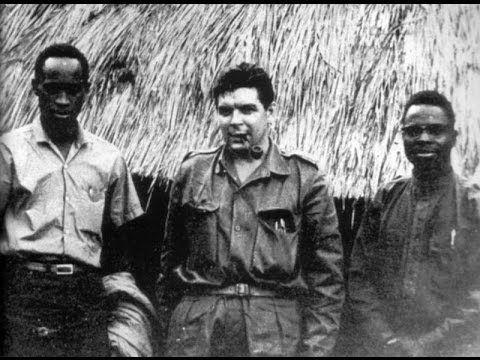
Ernesto "Che" Guevara in the Congolese bush in 1964 engaging in military training with Congolese comrades against imperialist backed neo-colonial forces.
Today there is a never ending barrage of attacks against the Cuban Revolution in general, and Ernesto "Che" Guevara in particular. Those attacks come regularly from the reactionary capitalist right wing as well as from the reactionary European so-called left. The truth about Che's role in establishing the groundwork in Africa that led to all of Southern Africa escaping racist segregation is the reason why we will always completely oppose anyone who challenges the legitimate legacy of comrade Guevara.
In 1964 Cuba was just five years into building its revolution after defeating the U.S. backed dictatorship of Fulgensio Batista in 1959. Che Guevara served as a national minister within the Cuban government, playing a role in assisting in planning national food production as well as helping establish the new country's banking structure. Guevara, who had earned universal respect in Cuba, despite being an Argentine by national origin, due to his fearless leadership on the battlefield during the Cuban revolutionary war, also played a major role in helping facilitate the La Habana trials in 1960. Those trials prohibited the masses of people in Cuba from immediately ending the lives of hundreds of people accused of carrying out crimes against the people under the Batista regime. Also the enemies of socialism use those trials to wrongfully accuse Guevara, and the Cuban government, of brutality against their own people, the truth is without Guevara's role in facilitating those trials, justice would not have been served to nearly the extent that it was during that period.
Being the international soldier for justice and human liberation that he was, Guevara was never content with what he helped accomplish in Cuba. As Cuba, like the rest of the peace loving world, watched in complete horror as the U.S., Belgium, and the rest of the imperialist world engineered the illegal sabotage and destruction of the democratically elected government in the Congo in 1960/61, Cuba took action to support the Congolese people. That support didn't just rest with rhetoric or simple food packages. Cuba mobilized troops to sail to Africa, trek through the countryside, and end up in the Congo to assist the remnants of Patrice Lumumba's National Congolese Movement (MNC) in their efforts to wage guerrilla warfare against the imperialist backed forces of (then) Joseph Mobutu. Guevara himself, led the contingent of approximately 100 Cubans into the Congo. Taking on the Ki-Swahili name "Tatu" (number two), Guevara helped train Congolese combatants. Unfortunately, fierce terrain, problems with coordination, and the complete onslaught of international imperialism, prevented the people's forces in the Congo from being successful. After the decision to withdraw, many of the Cubans returned to Cuba, but Guevara instead went to Tanzania where he stayed in the Cuban Embassy there for a few months. It was during this time that Guevara was able to initiate and strengthen contacts throughout the African continent that led to Cuban building strong relationships with the emerging liberation movements in Guinea-Bissau (the African Party for the Independence of Guinea-Bissau or PAIGC), Angola (the Popular Movement for the Liberation of Angola or MPLA), Mozambique (Mozambique Liberation Front), Namibia - then Southwest Africa (Southwest African People's Organization), and the liberation movements operating within Azania, South Africa (the African National Congress, Pan-Africanist Congress of Azania, Azanian People's Organization, Black Consciousness Movement).
In early 1965, Guevara returned to Cuba undercover. He would eventually move forward with the ill-fated mission in Bolivia that cost him his life in 1967, but the contacts he helped initiate from his 1964 mission in the Congo went on to flourish in Africa. Cuban comrades like Victor Dreke Cruz further developed political and military cooperation in Africa. Leaders of these African liberation movements traveled to Cuba to meet with Fidel Castro and other leaders of the Cuban Revolution. Cuba then played a role in helping train PAIGC fighters stationed in Guinea under the protection of Sekou Ture and the Democratic Party of Guinea. And, in Southern Africa, as racist apartheid proponents in that region of the world began to implement plans to consolidate their control over Azania, South Africa, by expanding their influence into the rest of Southern Africa, Cuba quietly sent almost half a million troops to Southern Africa to fight between 1975 and 1991. This mission, code named "Carlota" after the African Maroon women who led slave revolts in Cuba, was the decisive factor in several groundbreaking historical occurrences in Southern Africa. First, without Cuba's role, its conceivable that not only Azania, South Africa, but Namibia, Mozambique, Angola, Zimbabwe, and Zambia, would be under apartheid rule today. In other words, all of Southern Africa would today be ruled by racist settler colonialism. When the racists and their hired mercenary soldiers moved to consolidate their power, they did so with the full support of the U.S. and the racist settler regime in occupied Palestine (Israel). By the contrary, our Southern African liberation movements received heartfelt, but resource limited support from the Libyan Jamihiriya, but no one else in Africa after the death of Sekou Ture in 1984. Without Cuba's commitment and determination to prevent racist apartheid, its very difficult to imagine the potential that exists today. As a part of the negotiated settlement to have Cuba withdraw from Southern Africa, Angola, Mozambique, Zimbabwe, and Zambia, all were strengthened in their effort to consolidate those newly independent countries. Namibia's independence was a direct result of the negotiated settlement as well as the release of Nelson Mandela from the Robben Island prison. As for Cuba, all they received was the knowledge that they had made an overwhelming contribution to the forward progress of Africa and all of humanity.
in 2018, those historical events are significant for several reasons. The fact a small island country like Cuba of no more than 11 mission people could rise up and help defeat a collection of imperialist regimes supported by the U.S. says volumes about the power and capabilities of socialism once implemented. This is certainly a lesson we carry forward in our quest to build one unified socialist Africa. On that same note, the beating back of racist policy in Southern Africa places us in the position today to continue to build African unity, a process that surely would have been hurdled backwards without Cuba's assistance. And, all of this would be extremely difficult to imagine without the courage, commitment, and determination of one Ernesto "Che" Guevara. Our enemies are making every effort possible to tarnish his image. They even stoop so low as to dig out unflattering comments he made about African people while in his early twenties, before his quest for political consciousness began. They do this despite the obvious reality that all of us make and have made ignorant comments before our eyes have been opened by the glorious history of people's righteous struggle for justice. Yet, our enemies do this because many people, unable or unwilling to study these issues deeply, are easily thrown into confusion. So, that's why we intend to continue to set the record straight. Che Guevara, through his own deeds, was a great friend to Africa and African people. We owe him and the Cuban people (many who of course are African themselves) a great debt of revolutionary solidarity and gratitude. And, we encourage all to employ the words of Malcolm X when he correctly said that "any enemy of your enemy is a friend to you." Che was our friend. The Cuban Revolution is our friend. And, as we march forward in our work to make our contribution to Africa's liberation, Che's place in our history will be cemented forever.
In 1964 Cuba was just five years into building its revolution after defeating the U.S. backed dictatorship of Fulgensio Batista in 1959. Che Guevara served as a national minister within the Cuban government, playing a role in assisting in planning national food production as well as helping establish the new country's banking structure. Guevara, who had earned universal respect in Cuba, despite being an Argentine by national origin, due to his fearless leadership on the battlefield during the Cuban revolutionary war, also played a major role in helping facilitate the La Habana trials in 1960. Those trials prohibited the masses of people in Cuba from immediately ending the lives of hundreds of people accused of carrying out crimes against the people under the Batista regime. Also the enemies of socialism use those trials to wrongfully accuse Guevara, and the Cuban government, of brutality against their own people, the truth is without Guevara's role in facilitating those trials, justice would not have been served to nearly the extent that it was during that period.
Being the international soldier for justice and human liberation that he was, Guevara was never content with what he helped accomplish in Cuba. As Cuba, like the rest of the peace loving world, watched in complete horror as the U.S., Belgium, and the rest of the imperialist world engineered the illegal sabotage and destruction of the democratically elected government in the Congo in 1960/61, Cuba took action to support the Congolese people. That support didn't just rest with rhetoric or simple food packages. Cuba mobilized troops to sail to Africa, trek through the countryside, and end up in the Congo to assist the remnants of Patrice Lumumba's National Congolese Movement (MNC) in their efforts to wage guerrilla warfare against the imperialist backed forces of (then) Joseph Mobutu. Guevara himself, led the contingent of approximately 100 Cubans into the Congo. Taking on the Ki-Swahili name "Tatu" (number two), Guevara helped train Congolese combatants. Unfortunately, fierce terrain, problems with coordination, and the complete onslaught of international imperialism, prevented the people's forces in the Congo from being successful. After the decision to withdraw, many of the Cubans returned to Cuba, but Guevara instead went to Tanzania where he stayed in the Cuban Embassy there for a few months. It was during this time that Guevara was able to initiate and strengthen contacts throughout the African continent that led to Cuban building strong relationships with the emerging liberation movements in Guinea-Bissau (the African Party for the Independence of Guinea-Bissau or PAIGC), Angola (the Popular Movement for the Liberation of Angola or MPLA), Mozambique (Mozambique Liberation Front), Namibia - then Southwest Africa (Southwest African People's Organization), and the liberation movements operating within Azania, South Africa (the African National Congress, Pan-Africanist Congress of Azania, Azanian People's Organization, Black Consciousness Movement).
In early 1965, Guevara returned to Cuba undercover. He would eventually move forward with the ill-fated mission in Bolivia that cost him his life in 1967, but the contacts he helped initiate from his 1964 mission in the Congo went on to flourish in Africa. Cuban comrades like Victor Dreke Cruz further developed political and military cooperation in Africa. Leaders of these African liberation movements traveled to Cuba to meet with Fidel Castro and other leaders of the Cuban Revolution. Cuba then played a role in helping train PAIGC fighters stationed in Guinea under the protection of Sekou Ture and the Democratic Party of Guinea. And, in Southern Africa, as racist apartheid proponents in that region of the world began to implement plans to consolidate their control over Azania, South Africa, by expanding their influence into the rest of Southern Africa, Cuba quietly sent almost half a million troops to Southern Africa to fight between 1975 and 1991. This mission, code named "Carlota" after the African Maroon women who led slave revolts in Cuba, was the decisive factor in several groundbreaking historical occurrences in Southern Africa. First, without Cuba's role, its conceivable that not only Azania, South Africa, but Namibia, Mozambique, Angola, Zimbabwe, and Zambia, would be under apartheid rule today. In other words, all of Southern Africa would today be ruled by racist settler colonialism. When the racists and their hired mercenary soldiers moved to consolidate their power, they did so with the full support of the U.S. and the racist settler regime in occupied Palestine (Israel). By the contrary, our Southern African liberation movements received heartfelt, but resource limited support from the Libyan Jamihiriya, but no one else in Africa after the death of Sekou Ture in 1984. Without Cuba's commitment and determination to prevent racist apartheid, its very difficult to imagine the potential that exists today. As a part of the negotiated settlement to have Cuba withdraw from Southern Africa, Angola, Mozambique, Zimbabwe, and Zambia, all were strengthened in their effort to consolidate those newly independent countries. Namibia's independence was a direct result of the negotiated settlement as well as the release of Nelson Mandela from the Robben Island prison. As for Cuba, all they received was the knowledge that they had made an overwhelming contribution to the forward progress of Africa and all of humanity.
in 2018, those historical events are significant for several reasons. The fact a small island country like Cuba of no more than 11 mission people could rise up and help defeat a collection of imperialist regimes supported by the U.S. says volumes about the power and capabilities of socialism once implemented. This is certainly a lesson we carry forward in our quest to build one unified socialist Africa. On that same note, the beating back of racist policy in Southern Africa places us in the position today to continue to build African unity, a process that surely would have been hurdled backwards without Cuba's assistance. And, all of this would be extremely difficult to imagine without the courage, commitment, and determination of one Ernesto "Che" Guevara. Our enemies are making every effort possible to tarnish his image. They even stoop so low as to dig out unflattering comments he made about African people while in his early twenties, before his quest for political consciousness began. They do this despite the obvious reality that all of us make and have made ignorant comments before our eyes have been opened by the glorious history of people's righteous struggle for justice. Yet, our enemies do this because many people, unable or unwilling to study these issues deeply, are easily thrown into confusion. So, that's why we intend to continue to set the record straight. Che Guevara, through his own deeds, was a great friend to Africa and African people. We owe him and the Cuban people (many who of course are African themselves) a great debt of revolutionary solidarity and gratitude. And, we encourage all to employ the words of Malcolm X when he correctly said that "any enemy of your enemy is a friend to you." Che was our friend. The Cuban Revolution is our friend. And, as we march forward in our work to make our contribution to Africa's liberation, Che's place in our history will be cemented forever.

 RSS Feed
